
Robots have been driving on Mars for decades, sending back photos and samples of rock. But a human mission is a completely different challenge. People first walked on the Moon in 1969, so why is Mars still out of reach so many years later? Here’s why.
What’s already there
Mars is the most explored planet after Earth. The Viking landers touched down in 1976. Then came small rovers like Sojourner (1997), the twin rovers Spirit and Opportunity (2004), and the car-sized Curiosity (2012) and Perseverance (2021). Perseverance even brought a small helicopter, Ingenuity, which made the first powered flights on another planet. China landed its own rover, Zhurong, in 2021.
These missions taught us a lot about Mars. They also showed how hard it is to get there: many earlier missions failed on the way or crashed on landing.
It’s very, very far
The Moon is about 384,000 km away, and astronauts got there in three days. Mars is on average about 225 million km from Earth, and the distance changes a lot as both planets orbit the Sun.
With today’s rockets, the trip takes around six to nine months one way. And you can’t leave whenever you like. The best alignment of the planets, a launch window, comes only about every 26 months. A crew might have to stay on Mars for over a year before they can head home.
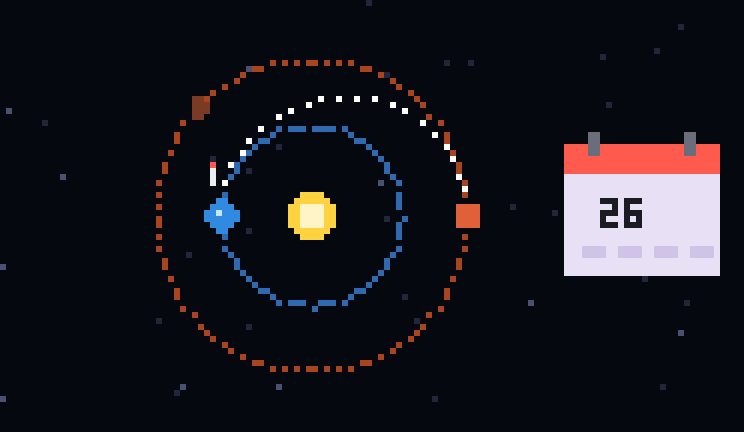 A spacecraft doesn’t fly straight. It follows an arc around the Sun (white dots). It launches when Mars is a little ahead of Earth (dark dot) and meets it on the far side of the orbit. This alignment comes back roughly every 26 months.
That changes everything. An Apollo crew in trouble could turn around and be home in days. A Mars crew can’t. Once they leave, they’re committed to a mission of around two to three years in total.
Radiation
On Earth, our atmosphere and magnetic field protect us. In deep space, and on Mars, which has a very thin atmosphere and no global magnetic field, astronauts would be exposed to much more cosmic radiation. Over a mission lasting two or three years, that raises the risk of cancer and other health problems. Shielding helps, but it’s heavy, and weight is the most expensive thing in spaceflight.
There are two kinds of danger. Cosmic rays from distant parts of the galaxy are constant and very hard to block. Solar storms are rarer, but can be intense. For those, a spacecraft could have a small, heavily shielded shelter where the crew waits until the storm passes. Instruments on Curiosity measured radiation during its trip, and the results showed that the journey alone would use up a large part of the dose astronauts are allowed over their whole career.
Landing is hard
Mars’s atmosphere is thin, about 1% of the pressure at Earth’s surface, but it’s still there. It’s too thin to slow a heavy spacecraft with parachutes alone, and thick enough to heat it up. Engineers call the landing “seven minutes of terror”, because it all happens automatically: radio signals take too long for anyone on Earth to help.
So far we’ve landed robots weighing about a tonne. Perseverance used a heat shield, a parachute and finally a “sky crane” that lowered the rover on cables. A crewed mission would need to land many tonnes of people, supplies and equipment, safely and precisely. That requires new techniques, such as large rockets firing during the descent.
Staying alive for years
A crew needs air, water, food and power for the whole trip, plus a way to fix things with no help from Earth. Radio signals take between a few minutes and over 20 minutes each way, so live conversation with mission control is impossible. When Mars is on the other side of the Sun, communication can be cut off completely for about two weeks.
Mars itself is not friendly either. The average temperature is around −60 °C. Gravity is about 38% of Earth’s, and we don’t know exactly what living in it for a year does to the human body. The fine dust gets into everything, and the soil contains chemicals called perchlorates, which are toxic to people.
One solution is to use what’s already on Mars. Perseverance carried a small experiment called MOXIE, which successfully produced oxygen from the Martian air. In the future, similar machines could make oxygen to breathe and fuel for the trip home. Ice under the surface could become water.
There’s also the psychological side: years in a small space with the same few people. Simulations on Earth, where volunteers live isolated in “Mars habitats” for months, show how important crew selection and good relations are.
So when?
Space agencies and private companies have published plans, and dates are announced and moved regularly. SpaceX is developing its huge Starship rocket with Mars in mind, and NASA has its own long-term plans. Bold timelines have often slipped.
The realistic path goes through the Moon first: programmes like NASA’s Artemis aim to test long missions, habitats and equipment there, close enough to come home if something goes wrong.
Frequently asked questions
Why not just go faster?
Faster trips need much more fuel, and fuel adds weight, which needs even more fuel. New engines, such as nuclear propulsion, could shorten the trip, but they’re still being developed.
Could people live on Mars permanently?
Not without a lot of help. Every base would have to produce air, water, food and energy by itself, protect people from radiation and survive dust storms. It’s possible in theory, but far more difficult than a single visit.
Why go at all, if robots can do it?
Robots are slow and careful. A geologist on site could do in a day what a rover does in months. And there’s the big question of whether life ever existed on Mars, which people would be better equipped to answer.
Humans on Mars is not science fiction any more. But it’s an engineering project on a scale we’ve never attempted, and it will take longer than the most optimistic headlines suggest.


